
Intro
The definition of playing cards is a standard set of 52 varnished paper cards used often for card games
and magic tricks.{1}
Depending on the manufacturer, the quality of the cards may vary, but the most common material is
paper varnished with a top coat for sealant.
The word ‘cards’ don't necessarily mean playing cards, as card(s) can refer to tarot, debit and credit, or
any form of identification, a card is at its most basic a rectangle commonly made of paper or plastic
with information on it.{2, 3}
Playing cards have a deep history related all across Europe, China, and America with history spanning
as back as the 13th century and further.{3, 4}

History (1200-1600)
There is no concrete origin to who was the first to invent playing cards but it is believed to have originated from China, moving south then west spreading to India, Persia and Egypt roughly around 1250-1517 during Mamluk control, with trade routes opening it up to Europe.{4} The main countries mentioned in the history below will be bulletined
- Britain
- Spain
- France
- Germany
- Italy
- China
It’s important to note that all countries close to the ones I have listed play apart of the history and culture surrounding cards, but with documentation and generalization of history most credit is given to the bigger countries.
Where cards came from
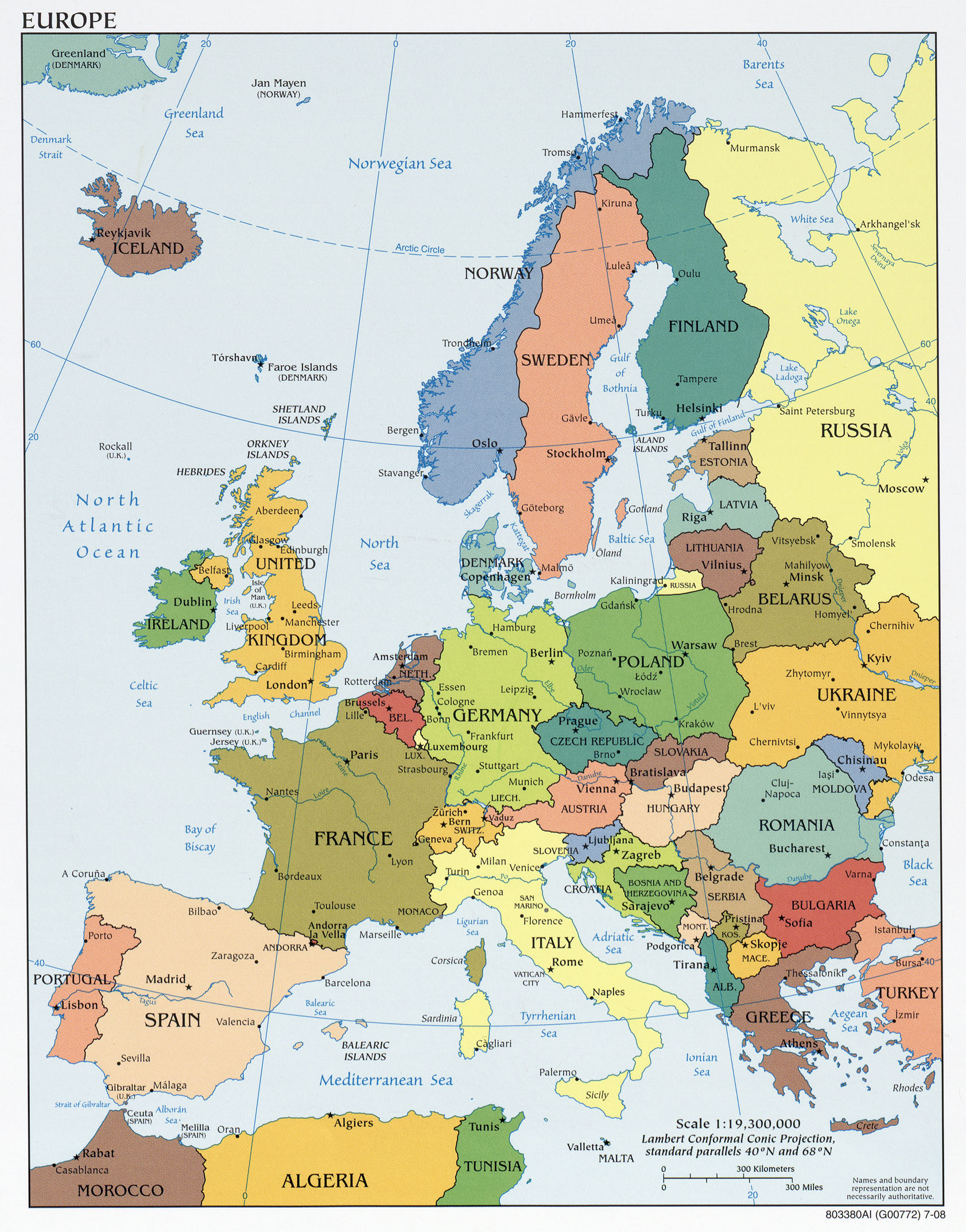
There is no origin point of invention as culture is shared and something like cards is very vast in what you can do and how you can interpret it. It's believed that in the late 1300s during the Crusades that soldiers along with playing chess also played cards, with that popularity of cards spread all throughout Europe. Playing cards are have said to originate from China, with the T'ang Dynasty having playing cards since 700 AD this is also believed because China invented printing and paper between 50 and 105 AD.{25} Along with armies, trading routes existed all across Europe, Asia, and Africa. As the Crusade century changed trading became a lot more common place leading to the spread of popularity of playing cards, and with the active advancement of machines many started to look for items to craft and sell. {4}
How society treated cards
Card games are a reflection of society, because of this certain eras have games suited to how cards were
mostly used, many of these games were created for the need to gamble.{4}
The Gothic age, from the 13th-15th centuries, saw huge economic and religious changes.
A new economy evolved, based on production a new hierarchical society was being developed in
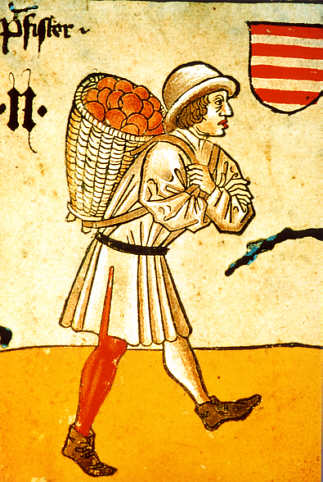
Europe, in which merchants and craftsmen played increasingly important roles, luxury playing cards
were produced in response of many other finer arts and crafts. {4}
As cards started to become more available to the general public, culture started to be formed mostly of
gambling. {4}
In fact the first references of playing cards was in the 1370s, with the first documented records of
playing cards were in the Cities of Bern and Florence with mentions of banning cards due to gambling.
In 1423 St Bernadin of Siena, an Italian Catholic priest, preached against games and playing cards,
convincing them to burn in "bonfires of the vanities" as cards then were directly linked to gambling.
Even went as far as being card "The Devils Picture Book".
Derogatory terms such as card-sharps, cheats, and swindlers were called many who played cards more
so on the gambler spectrum. {4,11, 12}
Even without cards gambling was still frowned upon by the church with dice and others banned from
the common public, even to this day public gambling is still banned. {4, 14, 15, 16,}
Production
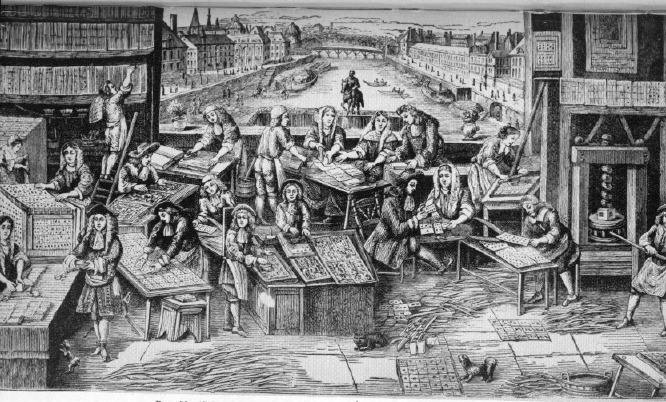
Playing cards started to be mass produced as the printing press made its way around, it being invented
in 1440 but becoming more popular and well used in the 15th century.{p,4}
Cards were fine art in some cases for the wealthier folk across Europe, to some degree this is even true today.{p}
Most cards that have survived throughout the medieval times are from the 15th century the cards being
produced mostly on paste boards.
Though the making of paper and cardboard, were mostly done by paper mills rather than the card
makers, which were mainly painters.{4}
Hand painted cards were of course higher quality than mass produced ones, not only for the images on
top but also the material used. More expensive cards had gold and silver accents compared to the black
and white mass produced cards although some had color too {4}
Everyone had a job when it came to production, the images shown on the cards (granted not personal
luxury cards) were commonly sketched on vellum and copied from workshops to create the pictures on
cards, granted this wasn't always perfect as it was a practice of lower quality card decks. {4}
Design choices directly reflect the resources available along with the culture at the time, this can even
still be said today.{4}
Old card decks
Note: The exact dates get blurry around here, there are so many conflicting sources I cannot say concretely
which of the decks mentioned below are the oldest from each other.
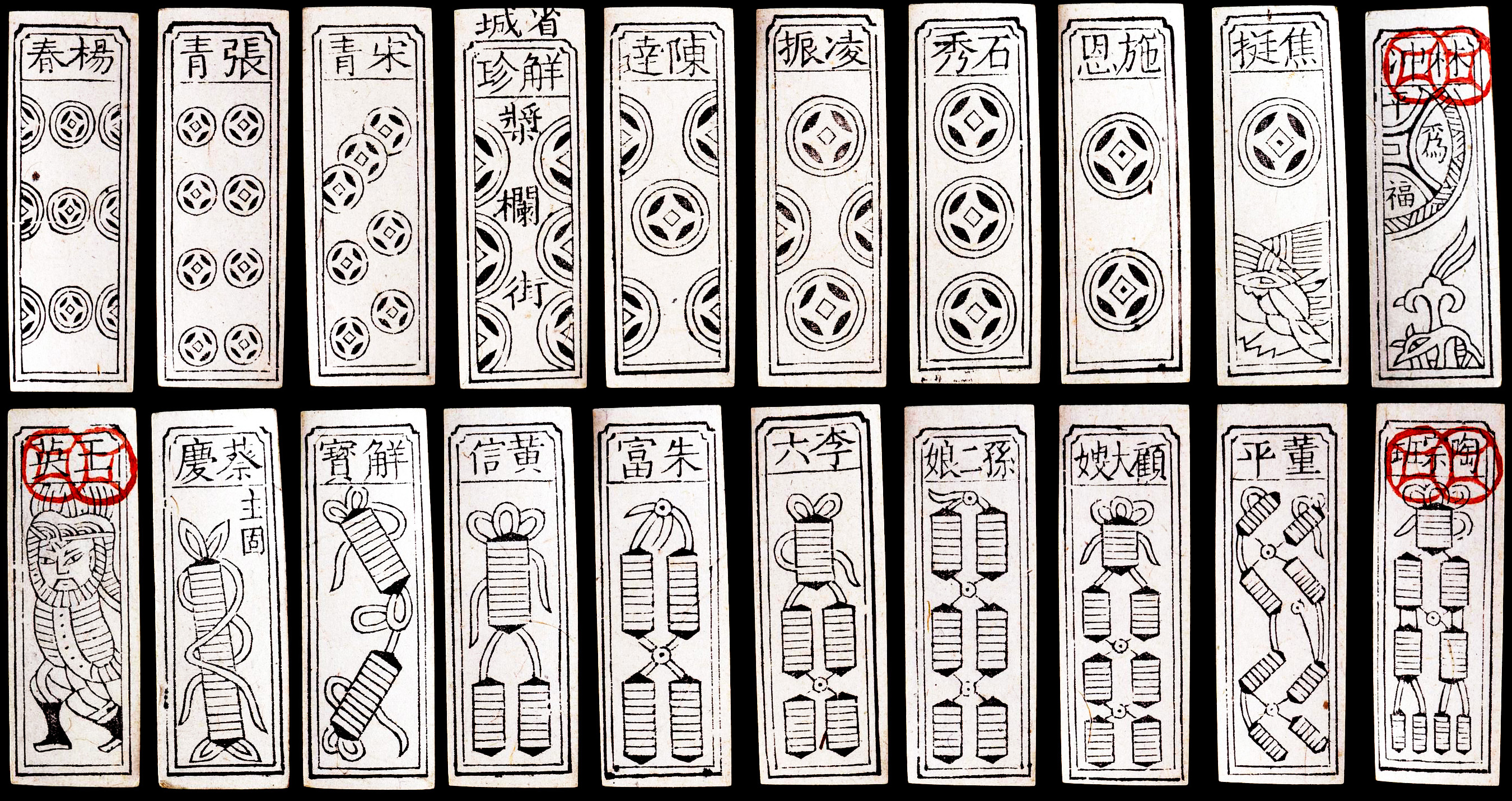
What is regarded as the oldest “card deck” (style may fit better) is the Chinese Money-Suited Cards, these cards
which are thought to be one of the first playing cards to have existed are based off of domino tiles which were
also created by the Chinese created around the Tang Dynasty which was around 9th centuray China.The deck heavily
related to gambling games hence the name money card along with trick games which have history across all cultures.
{17,31}
Modern cards of the same style.
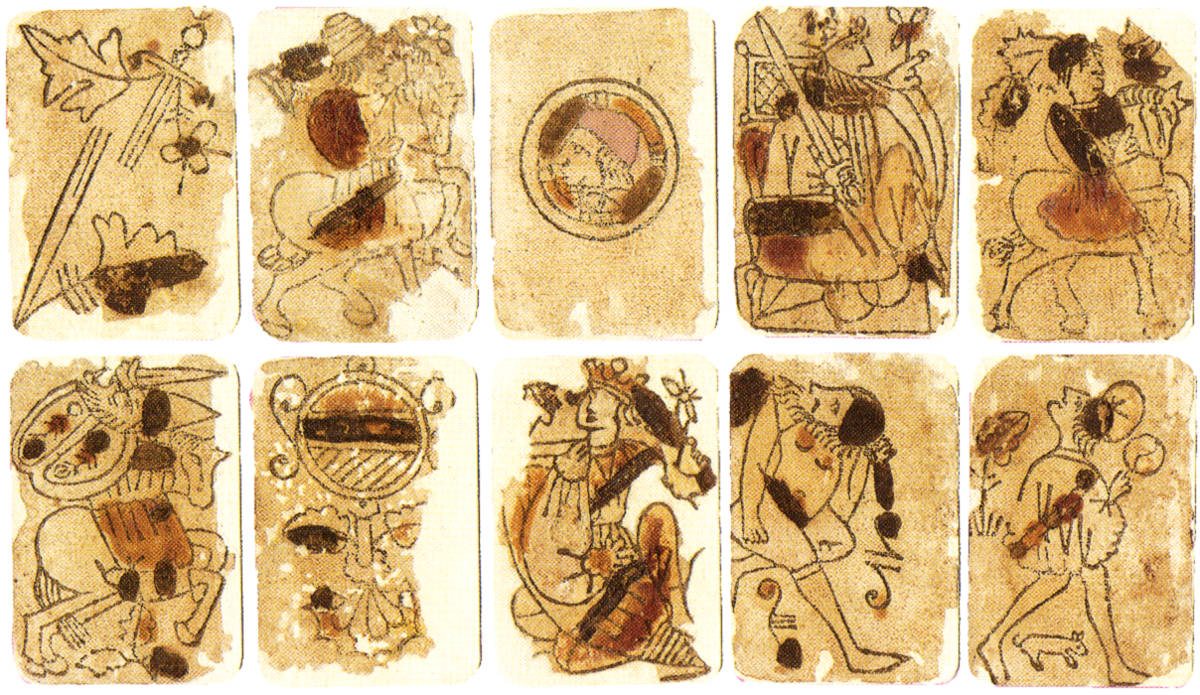
The oldest deck known supposedly is “Knave of Coins” this is the oldest known European deck, made somewhere
between 1390–1410. However some sources say that the deck was originally a tarot card deck meaning it would not "count"
as a playing deck.
Truth be told it was hard finding much information on this deck so interpreate as you will it can be
a tarot deck just as much as a playing deck due to the little known history{17, 24, 32}
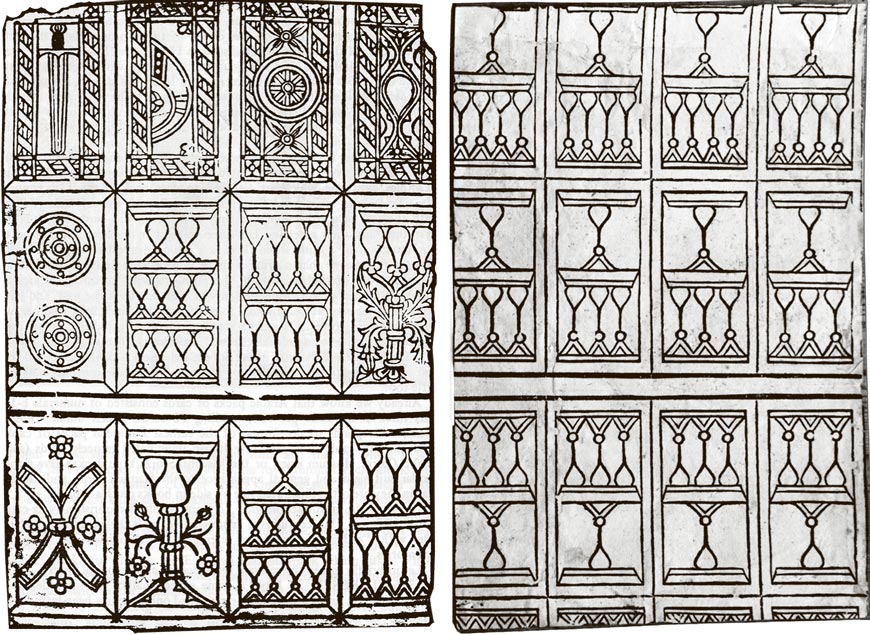
The turning point of cards in Europe was the Moorish Deck made around 1420 in Spain, being 2 uncut
sheets of paper made with a woodblock printing press featuring suits and pips shown on the design, with both
Islamic and European influences visiable, the Moorish deck is one of the oldest known European card decks that
is counted as a playing card deck, held in the Instituto Municipal de Historia in Barcelona located in Spain.
Note: I am unsure where they are held now nor if they are available for public veiw.
{4,10,8,33}
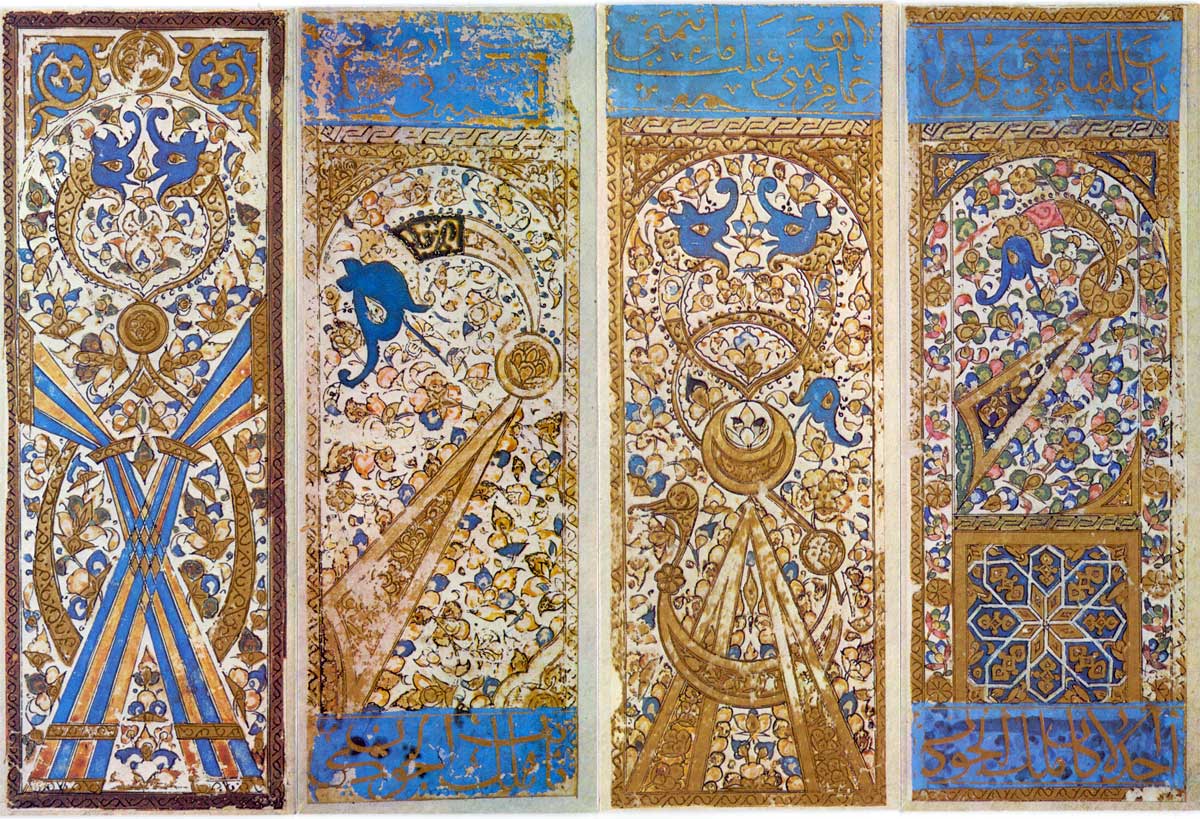
What is also regarded as one of the oldest playing cards is the Mamluk Deck.
This is the deck with the most account for history in this list (surprising ik).
Cards were originally made for more wealthier folk in production, and so because of this rich folk love
to be very fancy, the prime example of this are the Mamluk Cards.{4,5,7}
Mamluk Cards were created around the 15 century with heavy Islamic roots, and influence from the
Chinese Money-Suited Cards.
The most debate of these cards regard the suits many agree the suits shown are coins, cups, swords and polo-sticks.
Many of the cards have been lost over time making the deck only 47 cards total.
If the deck was completed it would have been a set of 52 cards, all hand painted. {7,8,}
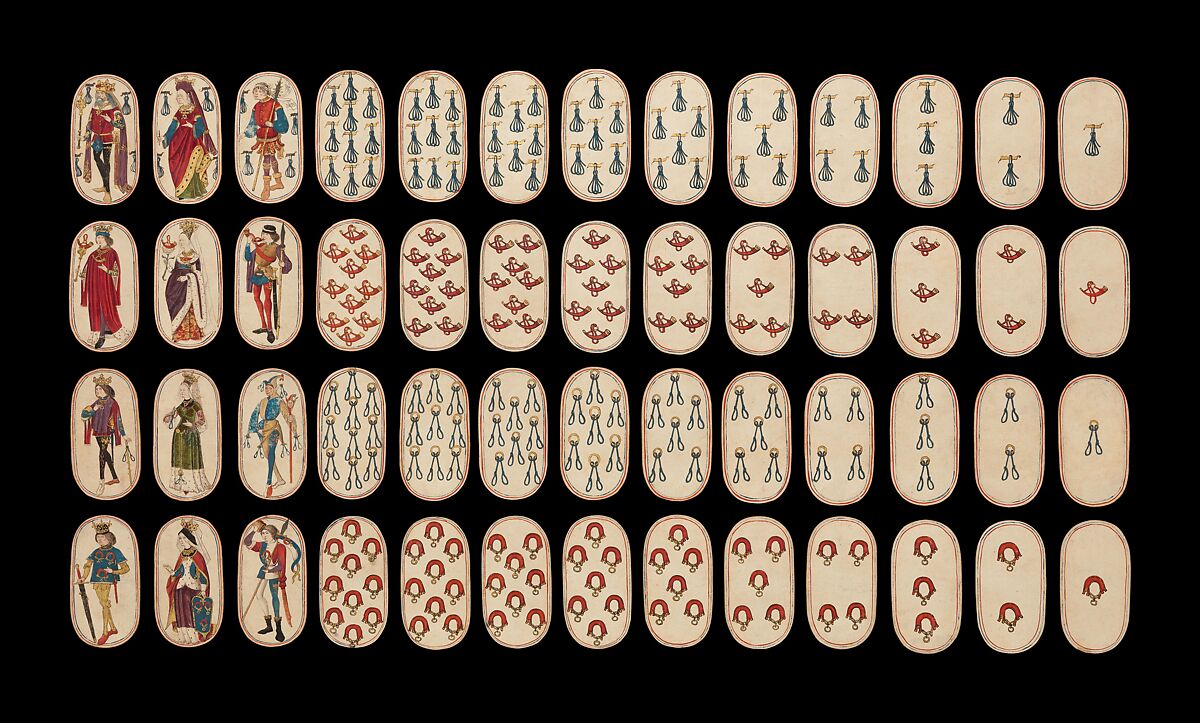
However the oldest complete deck of European playing cards are called the “Cloisters Playing Cards” or the
“Cloister Deck”, also called the “Flemish Deck” another variation "Flemish Hunting Deck", it is a set of 52 cards
created around the 15th centuryin the Burgundian territories which is around the Southern Netherlands.
Not much else can be said except that this deck is a good example of the turn of playing cards into the
traditional setup we know today with the cards pips 1-10, with a traditional European king, queen, and jack.
{5,6}
The Suits
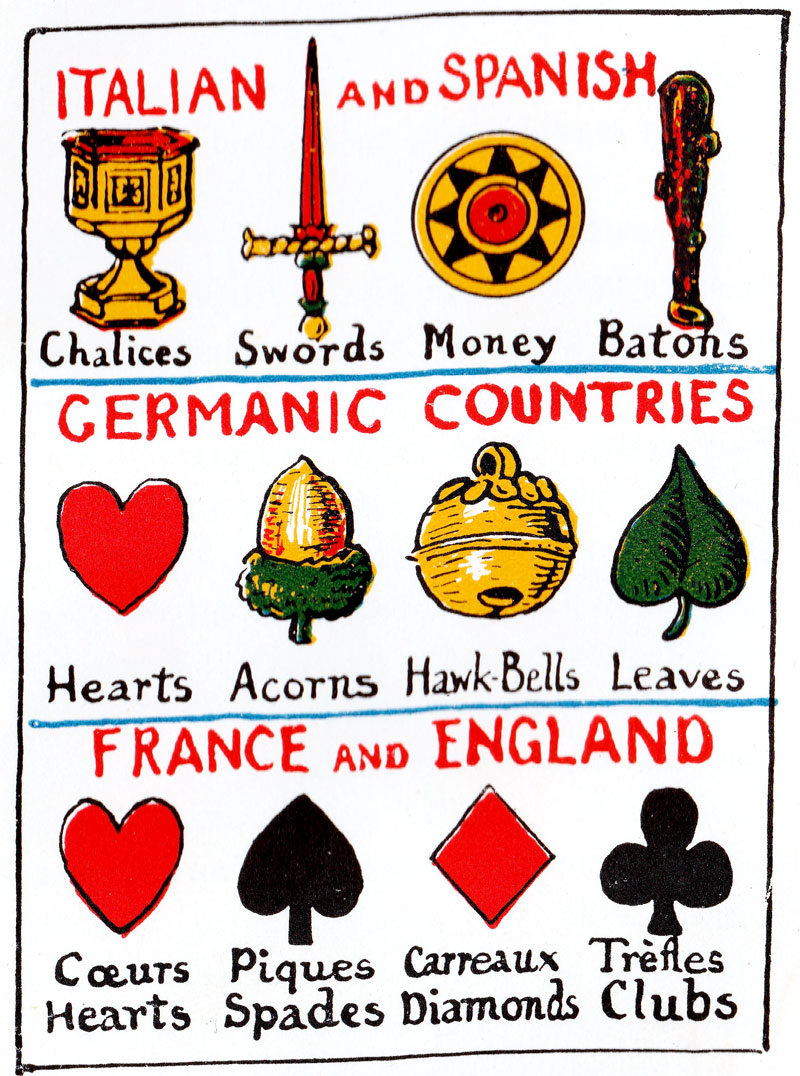
There wasn't a standard in Europe for the 4 suits yet, leading to many variations depending on the cultural background {5} • Objects that were depicted as suit symbols include, boars, bears, flowers, falcons, hounds, lions, clubs, cups, ciboria, hares, etc. What is most iconic and most known today is the French style of suits with hearts, clubs, spades, and diamonds What truly sets apart cards from region is not only the suits but the court cards, the region dictated the style of playing cards you were most likely to see. The cards that have changed the most through time is arguably the court cards, the court cards in Europe tended to represent the British rule of royalty, however with variations of region. Granted there are many variations of the court cards as some don’t even represent a court at all sometimes rather hunters, common folk, or not even people. Knave, kings, queens, jacks, princes, hunters, workers, knights, and many more are examples of what could and was displayed on the court cards.{p,4,23,} "Stereotyped designs peculiar to particular regions evolved and became standard patterns."{4, 15} A few differences in decks are: • "The Spanish packs also didn't have a 10, and with the absence of 8s and 9s in the national Spanish game of ombre, it resulted in a 40 card deck." • " The queen was also eliminated from the Italian courts, and these instead consisted of a King and two knaves, an obermann (upper) and untermann (under). Meanwhile the Two replaced the Ace as the highest card, to create a 48 card deck. For the French however: • "the French developed the icons for the four suits that we commonly use today, namely hearts, spades, diamonds, and clubs, although they were called coeurs, piques, carreaux, and trefles " • They also used only 2 colors for their suits for ease of production and play{20, 21} How the french made the 4 suits most iconic war by simplifying both German and Spanish suits, and by adding their own inspirations for the court cards with The French card suits based their designs off of German and Spanish card suits that existed before, the court cards with kings, queens, and jacks were loosely based off people in history.
- King of Hearts- Charlemagne ♥
- King of Spades- King David ♠
- King of Clubs- Alexander the Great ♣
- King of Diamonds- Julius Caesar ♦
- Queen of Hearts-Judith ♥
- Queen of Spades-Athena ♠
- Queen of Clubs-Argine ♣
- Queen of Diamonds-Rachel ♦
- Jack of Hearts- Étienne de Vignolles ♥
- Jack of Spades- Hogier ♠
- Jack of Clubs- Lancelot du Lac ♣
- Jack of Diamonds- Hector of the Fens ♦
Its important to note that the current cards seen today do not take after the same references, and that many decks did not survive during the time, along with the fact that a lot of decks were of art of royal people in general not any specifics. {27,28,29,30} Also fun fact! Nintendo originally started as a card making company, the original name being Nintendo Koppai. {18,19}
Click to see refrences
1 - https://dictionary.cambridge.org/us/dictionary/english/playing-card
2- https://dictionary.cambridge.org/us/dictionary/english/card
3- https://en.wikipedia.org/wiki/Playing_card
4 - https://www.wopc.co.uk/the-history-of-playing-cards/
5 - https://www.atlasobscura.com/articles/history-of-playing-cards
6 - https://www.metmuseum.org/art/collection/search/475513
7 - https://www.wopc.co.uk/egypt/mamluk-playing-cards
8 - http://mamluk.spiorad.net/history.htm
9 - https://www.themahjongtileset.co.uk/money-suited-playing-cards/
10 - https://www.kickstarter.com/projects/urbanincarnations/trzes-moorish-deck
11 - https://catholicstewardship.com/stewardship-saint-for-may-saint-bernardine-of-siena/
12 - https://www.newadvent.org/cathen/02505b.htm
13 - https://www.dailystep.com/english-idioms-originated-card-playing/
14 - https://www.historyofinformation.com/detail.php?id=276
15 - https://www.mrsblackwell.com/journal/history-of-playing-cards
16 - https://trionfi.com/card-playing-laws-florence
17 - https://libguides.ucalgary.ca/c.php?g=255446&p=1703612
18 - https://en.wikipedia.org/wiki/Nintendo
19 - https://www.wopc.co.uk/japan/japanese-playing-cards
20 - https://playingcarddecks.com/blogs/all-in/history-playing-cards-modern-deck?srsltid=AfmBOopty5EqMk2HHzJmZNKDmDZOtHo4QL6bzep2myGzgi5E-3bM0h2K
21 - https://en.wikipedia.org/wiki/Crusades
22 - https://www.awesomedice.com/blogs/news/history-of-dice?srsltid=AfmBOorpUIXhWiGW2--q5X4zRx69M-T-Dsz9PNAff6YqEgm0XvtQC5I0
23 - https://www.wopc.co.uk/playing-cards/history-of-court-cards
24 - https://www.historyofinformation.com/detail.php?id=276
25 - https://whiteknucklecards.com/history/briefhistory.html
26 - https://www.wopc.co.uk/the-history-of-playing-cards/early-history-of-playing-cards
27 - https://history.howstuffworks.com/history-vs-myth/kings-queens-and-jacks-playing-cards-real-people.htm
28 - https://www.grunge.com/1078381/who-the-kings-on-playing-cards-are-said-to-represent/
29 - https://en.wikipedia.org/wiki/French-suited_playing_cards
30 - http://www.madore.org/~david/misc/cards.html
31 - https://www.themahjongtileset.co.uk/money-suited-playing-cards/
32 - https://cards.old.no/1400-morisca/
33 - https://www.scribd.com/document/437994568/A-Moorish-Sheet-of-Playing-Cards
34 - https://cards.old.no/
ACE
The ace in modern decks is represented as the first in order in a deck, being the one to the set line of
numeral cards:
Ace, 2, 3, 4, 5, 6, 7, 8, 9, 10, jack, queen, king
Ace can be high or low depending on the game, low being 1, high being above the king.{p}
Historically, the ace had a low value and this still holds in many popular European games in fact many
European decks, including the French- and Latin-suited decks, do not use the Ace as the ace is the
death card{8}
Ace is a word stemming from old Latin for "as" before the French adopted it turning it into "a single
unit" or more simply "unit"
The modern definition of ace directly links to playing cards, being a word also to describe at being
really good at something with phrases like:
• "An ace up the sleeve"
• "Aced it"
• "to hold all the aces"
An interesting history regarding the ace card comes from taxation in Britain, in the 17th century wars
needed funding and so taxes were put on playing cards, aces had the most empty space and so they
were used to print a duty tax stamp.
"Packs were stamped in the country of use, not in the country of production"
The stamped cards were apart of the 1765 Stamp Act in which documents and cards were stamped to
symbolize paying a tax, however it wasn’t just
playing cards as it was for any stamped paper they
were called revenue stamps.
The taxes were to pay for the British Military
stationed in America after the French and Indian
War.{5, 6, 7}
To prevent fraud, officials started printing their own
Ace of Spades, in 1765 an act was passed making it
where forging an ace of spades was now a criminal
offense punishable by death, which is partly why
the ace of spades is associated with death as many
were hanged for forging a false ace.
Card makers then started to create their own special designs for the ace, later on the designs of the ace
became important to major brands as the ace of spade designs were perfect for trademarking and brand
recognition.
Also in the 17th century James 1 and Queen Anne enforced laws that the ace of spades be the insignia
of the printing house, during Jame’s rule it was extended to playing cards until 1711 and by Anne’s rule
it was until 1960.
"collected tax revenues on playing cards by making the card-makers buy their aces from the Stamp
Office, which were printed by the Government"{8, 9}
A famous artist of the ace of spades is George Gorgas White or G. G. White,
an illustrator who created the patented ace of spades design for The New York
Consolidated Card Company (NYCC) in 1882.
His works went on to inspire other card making companies for the high
detailed design on the ace of spades. {1, 2, 3, 4}
(go to American history for more on squeezers)
In war the ace of spades was used in the first world war as the British insignia, in the second world war
the 25th infantry division used the ace of spades as their insignia, and in ww2 paratroopers marked
their helmets with card symbols to distinguish of regiments just as much for good luck.
In the Vietnam war the ace of spades was superstitious as it was a symbol of death (or ill fortune)
related to the French colonial rule, because of this soldiers put an ace of spades card on dead bodies to
scare other potential enemies, in fact it was so common that United States Playing Card Company was
commissioned to make a deck of only ace of spades cards to use in war.{8, 1, 10}
1 - https://www.playsmart.ca/social-hub/those-amazing-aces/ 2 - https://www.wopc.co.uk/members/ken-lodge/72-the-ace-of-spades
3 - https://dictionary.cambridge.org/us/dictionary/english/ace 4 - https://fpopc.weebly.com/g-g-whites-card-designs.html 5 - http://www.endebrock.de/pc-taxes.html
6 - https://www.gilderlehrman.org/history-resources/spotlight-primary-source/stamp-act-1765 7 - https://en.wikipedia.org/wiki/Stamp_Act_1765
8 - https://en.wikipedia.org/wiki/Ace 9 - https://www.wopc.co.uk/members/ken-lodge/72-the-ace-of-spades
10 - https://cherrieswriter.com/2020/04/13/the-ace-of-spades-how-american-soldiers-used-the-death-card-as-a-psychological-weapon-during-the-vietnam-war/
HISTORY - AMERICAN
"Although cards were available in the Colonies prior to the Revolutionary War, the best modern researchers are fairly certain that the cards were actually printed in England and shipped over to the Colonies" Printing in the USA dint really take off until 1776 when America declare independence from Britain and began printing the standard French deck of playing cards, with an ace of spades without the British stamp tax (using Britain printing tech of course). Crehore decks were some of the more well known ones, made by US manufactures around the 1700s.
The main companies
One of the most well known manufacturers is Andrew Dougherty being known for his making of playing cards within the era of the second industrial revolution (1800s). Andrew Dougherty then went on to purchase from Thomas Crehore’s estate in 1847 entering the business of card making in the 1800s.{1, 2, 3, 4} Most companies operated in New York City but one company called Russell, Morgan & Co were located in Cincinnati, Ohio, and in June 1881 the first deck of playing cards were made, labeled "Tigers No. 101" the company had machines that could punch out decks the most efficiently that other competitors making them a staple in the new card making world. After the first deck many more followed labeled differently in direct order: • 101 Tigers • 202 Sportsman's • 303 Army and Navy • 404 Congress • 505 Army and Navy, gold edges • 606 Congress, gold edges
Deck History
Between 1850 and 1880 Bicycles became extremely popular with poorer people, an employee named Gus Berens suggested that the name be used and in July of 1885 as at the time bicycles were all the rave so the name might bring some attention. The first deck of cards made under the Bicycle brand was named "Fan" it failed slightly upon release but in 1887 the deck "Rider" became extremely popular, so much in fact that even today you can buy this deck from Bicycle {1, 5, 6, 7, 8,} One of the major changes that the US implemented in playing cards the two-way design on court cards, along with the numbers at the top and rounded corners. IMPORTANT NOTE: yes two way court cards along with rounded corners existed in Europe they were not widespread or mass produced By the 1870s cards have already been produced from manufactures for roughly 25 years in America.{8,p}\
Rivalry
beginning in 1893 a name change came the once Russell, Morgan & Co was now the USPCC (United States Playing Card Company), this marks a time where the USPCC started collecting other card making companies, slowly out buying and adopting other card and printing companies under its name. {1, 6, 10,} The Russell, Morgan & Co. would later on become the United States Playing Card Company (USPCC) established in 1894 under Russell, Morgan & Co{1, 5, 6, 7, 8,}with brands under its name like: • Bicycle • Bee • Tally-Ho • Champion • Congress • Aviator • Aristocrat • Mohawk • Maverick • KEM • Hoyle • Fournier. Companies fought being bought out with a new style of card called "Squeezers" first appeared in the 1870s, used as a marketing tool by the founders of NYCC (New York Card Company), From 1873 onward, all playing cards manufactured with indices by NYCC were referred to as Squeezers.’ They were also a brand of cards " first patented in the United States by Cyrus Saladee in 1864. “Squeezers” refers to the fact that the indices allowed a player to keep the cards squeezed together while examining them, rather than having to spread the cards widely and risk flashing one or more to an opponent." In 1876 the New York Consolidated Card. Company produced its Patented Squeezers brand. The NYCC was formed in 1871, and between 1894 and 1907 many card companies were bought out. " NYCC was a major player in the card manufacturing world, with roots going all the way back to the 1830s. L.I. Cohen, a stationer from New York City, invented a process for printing four different colors onto a playing card in one pass. After his death, his heirs formed three separate playing card companies, each using his four-color printing process. When pressure from other manufacturers forced them back together, they "consolidated" to form NYCC." "Easily the most recognizable brand from the NYCC days is the “Bee No. 92” brand. First released in 1892 " Which can still be bought today just like the rider deck "Most magicians are familiar only with the “Bee No. 67” back, which is the all-over diamond-back design. It’s used primarily for performing gambling-themed routines, as the all-over back design helps to disguise false deals and shuffles. " Tally-Ho cards were introduced in 1885 (the same year as Bicycles),Tally-Ho brand was primarily focused on the New York area.{1, 10,11, 12, 13, 14, 15, p}
Modern-ish
Throughout history a few bans have been placed on states of gambling, and in direct link, playing
cards, this mostly happened around the prohibition era where alcohol was banned, although granted not
for long. {1, p}
When war is struck playing cards, typically with propaganda are made, regardless of the century,
however in ww1 and ww2 many playing cards both of satirical and propaganda were made for soldiers
and citizens to use.
An important use of playing cards were for soldiers, in ww2 the USPCC directed production to
parachutes but also to making "spotter cards" used to recognize enemy equipment with patterns and
design on the cards.
Even today a similar tactic is used with the Iraq war a list of the top targets were made into playing
cards for soldiers to recognize who is who (“Most Wanted” deck).
Also in WW2 were few decks called "map decks" used by the British Intelligence to show save routes
and escape areas, many decks do not exist today but many recreations were made to preserve history
"Due to the top-secret nature of
the map decks, the project had
to remain confidential for
many years after the war. It is
unknown how many escape
map decks were produced or
survived. Only two full decks
are still known to exist. They
are both held in the collection
of the International Spy
Museum in Washington,
DC."{1, 15, 17,}
FUN FACT in 1971just before apollo 14 was about to be launched NASA
requested that a special deck of flameproof cards be made for the crew, the
USPCC then made the cards which are completely safe in a 100% oxygen
atmosphere the paper being safe from starting a fire {1, 17}
1 - https://www.vanishingincmagic.com/playing-cards/articles/history-of-american-playing-cards/ 2 - https://www.wopc.co.uk/usa/dougherty/andrew-dougherty-1850
3 - https://worldofpaperempires.com/andrew-dougherty 4 - https://www.wopc.co.uk/usa/caleb-bartlett
5 - https://www.wopc.co.uk/usa/the-united-states-playing-card-company/tigers-101 6 - https://en.wikipedia.org/wiki/United_States_Playing_Card_Company
7 - https://bicyclecards.org/cards_post/rider/
8 - https://playingcarddecks.com/blogs/all-in/why-you-are-probably-a-fan-of-andrew-dougherty-without-even-knowing-it?srsltid=AfmBOorE4Tn9SvIdX_MLNl8hiSOBTDWQw99LqxidijF4SFZClBt-rfw
9 - https://www.facebook.com/groups/BicycleCardCollectors/posts/605714499984759/ 10 - https://www.vanishingincmagic.com/playing-cards/articles/what-is-the-uspcc/
11 - http://wopc.co.uk/usa/nyccc/new-york-consolidated-card-company 12 - https://www.wopc.co.uk/usa/dougherty/dougherty-triplicate-restoration
13 - https://www.wopc.co.uk/usa/squeezers/squeezers-35 14 - https://worldofpaperempires.com/new-york-consolidated
15 - https://www.wopc.co.uk/usa/nyccc/new-york-consolidated-card-company 16 - https://www.wopc.co.uk/explore/theme/wartime/
17 - https://www.nps.gov/articles/000/stacking-the-deck-escape-cards-of-world-war-ii.htm
18 - https://www.wopc.co.uk/usa/the-united-states-playing-card-company/into-space-and-back
JOKERS
The joker cards is only fairly recent in the production of playing cards, with it only being produced in
the 1800s more specifically the 1860s created by the USPCC, the joker card is related to the game of
Euchre but its unsure whether it was coincidence or intended is unknown.
Euchre is a trick card game in which jokers are "Bowers" jokers being the highest trump card
"he name Best/Imperial Bower quickly changed to the Jolly Joker, and was shortened to just Joker."
Most games do not use the joker cards very few do and tend to be put off on the side or used as stand
ins for certain games or circumstances.
Joker cards do not count in a 52 deck of cards, they are additional but so common that you tend to
notice if they were missing.
"Jokers are jesters, part of the royal court. "
{1,2,3,4}
1 - https://luckandstrategy.com/what-card-games-use-jokers/ 2 - https://www.vanishingincmagic.com/playing-cards/articles/why-do-playing-cards-have-jokers/
3 - https://www.amusedbyjokersami.com/2024/09/investigating-great-invention-of-1800s.html 4 - https://learnplayfoundation.com/portfolio/just-because-the-joker/
All in all, card games bring people together throughout many times and spaces with tricks and games built over centuries, a simple deck can pass the time for hours. CARDS ARE AWESOME!!!



